
Neural networks – without formulas
Behind image recognition, speech recognition and chatbots there are neural networks. The name comes from the nerve cells (neurons) in the brain, but an artificial neuron is much simpler: it is a small calculation with addition and multiplication. In this lesson you will get to know one neuron, then a network – and try to “set up” a neuron yourself.
One artificial neuron
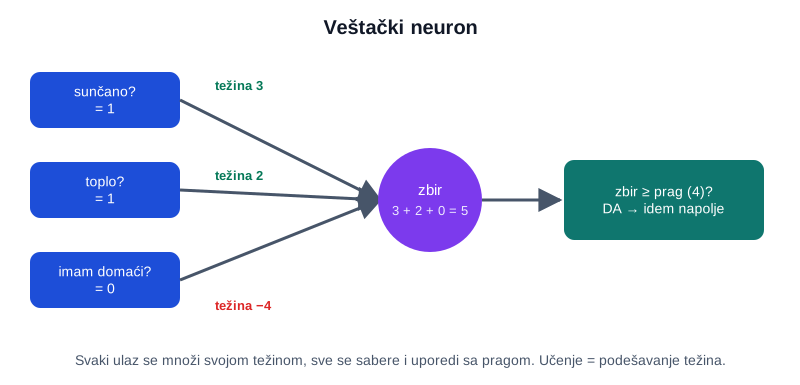
Imagine you are deciding whether to go outside. You look at several things (inputs), and some are more important to you than others:
- whether it is sunny – important, weight 3;
- whether it is warm – less important, weight 2;
- whether you have homework – it keeps you at home, weight −4 (negative!).
The neuron multiplies each input (1 = yes, 0 = no) by its weight, adds everything up and compares the sum with a threshold. If the sum is greater than or equal to the threshold – the decision is “yes”. For a sunny and warm day without homework: 1·3 + 1·2 + 0·(−4) = 5, and the threshold is 4, so the decision is “I'm going out”.
Try it yourself: change the inputs (0 or 1), the weights and the threshold – the neuron immediately calculates the decision “am I going out?”.
Try it: what happens when you have homework (input 1)? What weight should “sunny” have for you to go out even when you have homework?
What it means for a neuron to learn
In the example above we made up the weights ourselves. In machine learning the weights are not written by hand – they adjust themselves, based on examples:
- At the beginning the weights are random, so the neuron often makes mistakes.
- For each example, we check whether the decision is correct (we compare it with the label).
- If it was wrong, the weights are moved a little in the direction that would give the correct answer.
- This is repeated thousands of times – until the neuron starts guessing correctly.
This is training. The first neuron that learned like this was called the perceptron (Frank Rosenblatt, 1958) – you will build it in Python in the programming module.
From a neuron to a network
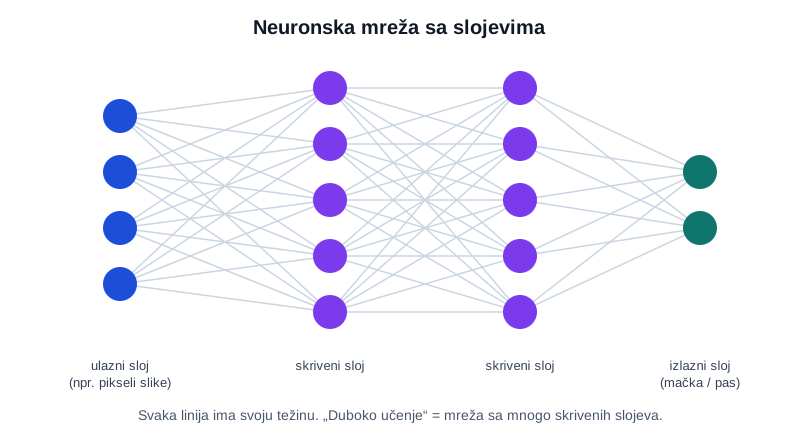
- One neuron can make only a simple decision. That is why neurons are arranged in layers: the outputs of one layer become the inputs of the next.
- The input layer receives the data (for example the brightness of each pixel of an image). The output layer gives the answer (cat or dog). In between are the hidden layers.
- The first layers in a network for images usually learn to recognize edges and lines, the next ones shapes (an eye, an ear), and the last ones whole objects.
- A network with many hidden layers is called a deep network – hence the name deep learning.
How big are networks?
| Network | Approximately how many weights (parameters) |
|---|---|
| the neuron from our game | 3 weights + threshold |
| a small network for handwritten digits | tens of thousands |
| a network for image recognition (for example in a phone) | several million |
| large language models (chatbots) | billions and more |
That is why training large networks takes days or months on thousands of computers – while a small network can be trained even on an ordinary laptop.
The brain and an artificial neural network
| The human brain | An artificial neural network | |
|---|---|---|
| the number of neurons | oko 86 milijardi | from a few to billions of “neurons” (calculation units) |
| how it learns | from few examples, all its life, from experience and the senses | from many examples, mostly only during training |
| what a neuron is | a living cell with complex chemical and electrical processes | one simple calculation: multiplication, addition, comparison |
| energy consumption | about 20 W (like a weak light bulb) | large models use much more electricity for training and running |
The idea was inspired by the brain, but an artificial network is not a copy of the brain. Even today we don't know much about how the brain learns.
Students in pairs look for neuron settings for given situations (for example “I go out only when it is sunny AND warm”), then explain which weights and threshold they chose.
Common misconceptions
- “A neural network is a small brain in a computer” – it is a set of simple calculations; it resembles the brain only in the idea of connected “neurons”.
- “The programmer enters all the weights” – the weights adjust themselves during training; the programmer chooses the shape of the network and the data.
Practice tasks
Try it yourself first, and only then open the solution.
- A neuron has the inputs x₁ = 1, x₂ = 0, x₃ = 1 and the weights 2, 5 and −1. What is the sum? What is the decision if the threshold is 1?
- Set up the neuron from the game so that you go out only when it is both sunny and warm (and homework doesn't affect the decision). Which weights and threshold would you choose?
- What is a “hidden layer”, and why is a network with many such layers called deep?
Solution 1: the calculation
1·2 + 0·5 + 1·(−1) = 1. The sum 1 ≥ threshold 1, so the decision is YES.
Solution 2: one possible solution
For example: weight for sunny 1, for warm 1, for homework 0, threshold 2. The sum is 2 only when both inputs are 1.
Solution 3: answer
A hidden layer is a layer of neurons between the input and the output; we don't see its values directly. A network with many hidden layers is “deep” because the data passes through many levels of processing – hence the name deep learning.
Check your knowledge
Open the quiz
Quiz: neural networks
1. What does one artificial neuron do?
2. Inputs 1, 1, 0; weights 3, 2, −4; threshold 4. What is the decision?
3. What changes during the training of a neural network?
4. What is deep learning?