
The nearest neighbor algorithm (k-NN) from scratch
How would you guess the type of an unknown fruit? You would probably compare it with fruits you know and say: “it looks most like apples”. The k-nearest neighbors algorithm (k-NN) works on this idea. We will write it ourselves, using only lists and loops.
The idea of the algorithm
- Each fruit is a point on the chart (x = mass, y = length).
- For a new fruit we calculate the distance to every known fruit.
- We take the k nearest (for example k = 3).
- They “vote”: the type that most of them have is our answer.
We calculate the distance between the points (x₁, y₁) and (x₂, y₂) using the Pythagorean theorem: √((x₁ − x₂)² + (y₁ − y₂)²).
An important step: scaling
The mass is in hundreds of grams (115–250), and the length in centimeters (7–21). A difference of 30 g would “count” much more in the distance than a difference of 10 cm – even though 10 cm is a huge difference for fruit. That is why we convert both features to the range from 0 to 1:
new value = (value − smallest) / (largest − smallest)
This way both features are equally important. You will see what happens without scaling in the first task.
The program
# The k-nearest neighbors algorithm (k-NN) – without libraries, only lists and loops
import csv
import math
import random

# 1) loading the data
data = []
with open("fruit.csv", encoding="utf-8") as f:
    for row in csv.DictReader(f):
        data.append((float(row["mass"]), float(row["length"]), row["kind"]))

# 2) scaling: mass (100–250) and length (7–21) have different ranges,
#    so we convert both features to the range 0..1 so that they are equally important
min_m = min(p[0] for p in data); max_m = max(p[0] for p in data)
min_d = min(p[1] for p in data); max_d = max(p[1] for p in data)


def scale(mass, length):
    return ((mass - min_m) / (max_m - min_m), (length - min_d) / (max_d - min_d))


examples = [(scale(m, d), v) for m, d, v in data]

# 3) splitting into training (80 %) and test (20 %) data
random.seed(1)                       # the same “random” order every time the program runs
random.shuffle(examples)
cut = int(len(examples) * 0.8)
train, test = examples[:cut], examples[cut:]


def distance(a, b):
    """The ordinary (Euclidean) distance between two points."""
    return math.sqrt((a[0] - b[0]) ** 2 + (a[1] - b[1]) ** 2)


def knn(point, k):
    """Return the type that the majority of the k nearest training examples have."""
    ordered = sorted(train, key=lambda p: distance(point, p[0]))
    votes = {}
    for _, kind in ordered[:k]:
        votes[kind] = votes.get(kind, 0) + 1
    return max(votes, key=votes.get)


# 4) checking the accuracy for several values of k
for k in [1, 3, 5]:
    correct = sum(1 for point, kind in test if knn(point, k) == kind)
    print(f"k = {k}: {correct} of {len(test)} correct ({correct / len(test) * 100:.0f} %)")

# 5) a new fruit
new_fruit = scale(200, 8.3)
print("A fruit of 200 g and 8.3 cm is:", knn(new_fruit, 3))
Program output:
k = 1: 5 of 6 correct (83 %)
k = 3: 5 of 6 correct (83 %)
k = 5: 5 of 6 correct (83 %)
A fruit of 200 g and 8.3 cm is: orange
random.seed(1)makes the “random” shuffling the same every time the program runs – that way we can compare the results.sorted(..., key=lambda p: distance(point, p[0]))sorts the examples from the nearest to the farthest.- The dictionary
votescounts the votes;max(votes, key=votes.get)returns the type with the most votes. - On the 6 test examples the model makes one mistake – it is an apple that is very close to the oranges.
Bonus: a decision map
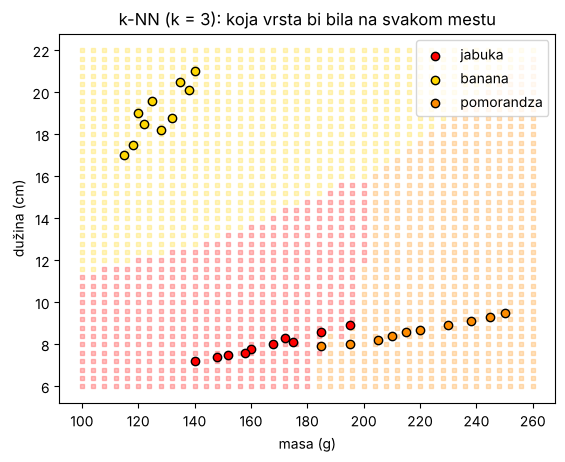
If we ask k-NN about every point of the plane, we get a map: which type would be in which place. The borders between the colors are the borders the model has “learned”.
# Bonus: a “decision map” – for every point of the plane k-NN says which type it would be
import csv
import math
import matplotlib.pyplot as plt

data = []
with open("fruit.csv", encoding="utf-8") as f:
    for row in csv.DictReader(f):
        data.append((float(row["mass"]), float(row["length"]), row["kind"]))

min_m = min(p[0] for p in data); max_m = max(p[0] for p in data)
min_d = min(p[1] for p in data); max_d = max(p[1] for p in data)


def scale(mass, length):
    return ((mass - min_m) / (max_m - min_m), (length - min_d) / (max_d - min_d))


examples = [(scale(m, d), v) for m, d, v in data]


def knn(point, k=3):
    ordered = sorted(examples, key=lambda p: math.dist(point, p[0]))
    votes = {}
    for _, kind in ordered[:k]:
        votes[kind] = votes.get(kind, 0) + 1
    return max(votes, key=votes.get)


colors = {"apple": "red", "banana": "gold", "orange": "darkorange"}
# a grid of points: mass from 100 to 260 g, length from 6 to 22 cm
for mass in range(100, 261, 4):
    for d10 in range(60, 221, 4):
        length = d10 / 10
        plt.scatter(mass, length, c=colors[knn(scale(mass, length))], s=12, alpha=0.25, marker="s")

for kind in colors:          # the real examples on top of the map
    plt.scatter([m for m, d, v in data if v == kind], [d for m, d, v in data if v == kind],
                c=colors[kind], edgecolors="black", label=kind)
plt.xlabel("mass (g)")
plt.ylabel("length (cm)")
plt.title("k-NN (k = 3): which type would be in each place")
plt.legend()
plt.show()
k-NN has no “training” in the real sense – it just remembers all the examples. That is why it is simple, but slow when there are a million examples: for each new fruit it has to calculate a million distances.
First, a “k-NN by hand”: on the printed chart, students draw a new fruit and use compasses to find the 3 nearest points. Then they write the program and check their answers.
Common misconceptions
- “k-NN “understands” fruit” – it only measures distances to known examples.
- “A bigger k is always better” – a too big k also asks distant examples; when k is equal to the number of all examples, the answer is always the type that has the most examples.
Practice tasks
Try it yourself first, and only then open the solution.
- Remove the scaling (use the mass and length as they are) and check what k-NN says for a small apple of 130 g and 8 cm.
- Write a program that classifies a list of new fruits at once: (150 g, 7.6 cm), (128 g, 18 cm), (240 g, 9.2 cm), (190 g, 8.3 cm).
- What would k-NN answer for any fruit if k were equal to the number of all training examples (24)? Why?
Solution 1: without scaling
# Task: k-NN WITHOUT scaling – mass “outvotes” length
import csv, math, random

data = []
with open("fruit.csv", encoding="utf-8") as f:
    for row in csv.DictReader(f):
        data.append(((float(row["mass"]), float(row["length"])), row["kind"]))

random.seed(1)
random.shuffle(data)
train, test = data[:24], data[24:]


def knn(point, k):
    ordered = sorted(train, key=lambda p: math.dist(point, p[0]))
    votes = {}
    for _, v in ordered[:k]:
        votes[v] = votes.get(v, 0) + 1
    return max(votes, key=votes.get)


correct = sum(1 for t, v in test if knn(t, 3) == v)
print(f"Without scaling: {correct} of {len(test)} correct")
# A fruit of 130 g and 8 cm (a small apple) – what does the model without scaling say?
print("130 g, 8 cm ->", knn((130, 8), 3))
Program output:
Without scaling: 5 of 6 correct
130 g, 8 cm -> banana
Without scaling, the small apple becomes a “banana”: by mass (130 g) it is closest to the bananas, and the difference in length (8 cm versus 18 cm) almost doesn't count. With scaling the answer is correct – an apple.
Solution 2: several fruits
# Task: classify several new fruits at once (k-NN with scaling, k = 3)
import csv, math

data = []
with open("fruit.csv", encoding="utf-8") as f:
    for row in csv.DictReader(f):
        data.append((float(row["mass"]), float(row["length"]), row["kind"]))
min_m = min(p[0] for p in data); max_m = max(p[0] for p in data)
min_d = min(p[1] for p in data); max_d = max(p[1] for p in data)


def scale(m, d):
    return ((m - min_m) / (max_m - min_m), (d - min_d) / (max_d - min_d))


examples = [(scale(m, d), v) for m, d, v in data]


def knn(point, k=3):
    ordered = sorted(examples, key=lambda p: math.dist(point, p[0]))
    votes = {}
    for _, v in ordered[:k]:
        votes[v] = votes.get(v, 0) + 1
    return max(votes, key=votes.get)


new_fruits = [(150, 7.6), (128, 18.0), (240, 9.2), (190, 8.3)]
for m, d in new_fruits:
    print(f"{m} g, {d} cm -> {knn(scale(m, d))}")
Program output:
150 g, 7.6 cm -> apple
128 g, 18.0 cm -> banana
240 g, 9.2 cm -> orange
190 g, 8.3 cm -> orange
Solution 3: explanation
Always the same – the type that has the most of the 24 training examples, because all the examples would vote regardless of distance. That is why k must be small compared to the number of examples (often 3, 5 or 7, odd so that there is no tie).
Check your knowledge
Open the quiz
Quiz: k nearest neighbors
1. How does k-NN decide?
2. Why are the features scaled to the range 0..1?
3. What does random.seed(1) do?
4. What is the disadvantage of k-NN when there are many examples?