
The Turing test and the “imitation game”
How can we know whether a machine is intelligent? In 1950 Alan Turing suggested a simple game instead of a difficult debate about what “thinking” is. That suggestion still sparks debates today – especially since chatbots started writing like people.
What the test looks like
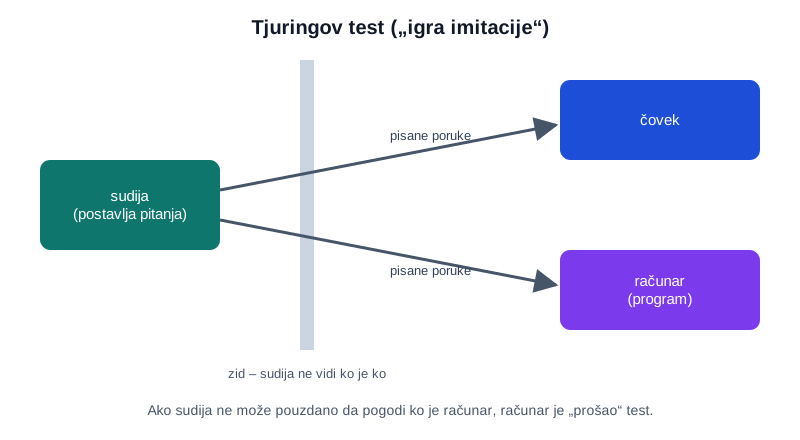
- The judge sits in one room, and a human and a computer in another. The judge can't see or hear them.
- The judge talks to both conversation partners only through written messages, about anything.
- At the end the judge tries to guess which one is the human and which one is the computer.
- If the judge can't reliably tell them apart, we say the computer has passed the test.
Turing called this the “imitation game”, because the computer tries to imitate a human.
Why the test was important
- It turned a philosophical question into an experiment that can be carried out.
- It focused attention on language – a conversation requires knowledge about the world, logic and imagination.
- For decades it was a goal that researchers worked towards.
Do today's chatbots pass the test?
In short conversations today's chatbots often sound like people, and in some experiments people couldn't reliably tell them from a human. Still, most scientists think this doesn't prove that a machine thinks or understands:
- Imitation is not understanding. A program can learn how people write without knowing what the words mean in the real world.
- The test depends on the judge. An inexperienced judge is easier to fool (remember ELIZA from 1966).
- The test measures only conversation. It doesn't check whether a machine can solve a new problem, cope in the real world or learn from few examples like a child.
That is why today artificial intelligence is tested with many other tests: math and programming tasks, reading comprehension tests, puzzles that require logic.
A thought experiment: the “Chinese room”
In 1980 the philosopher John Searle described an experiment: a person who doesn't know Chinese is locked in a room with a thick book of rules. Slips of paper with Chinese characters are passed in through an opening, and using the rules from the book the person puts together answers. From the outside it looks as if the room “knows Chinese” – but the person inside doesn't understand a word.
Searle wanted to show that correct answers don't mean understanding. Other philosophers disagree: maybe the whole system (the person + the book) “understands”, not the person alone. This debate continues today – more about it in the lesson about the consciousness of artificial intelligence.
Activity: the imitation game in class
- Choose a judge and two “conversation partners”. One partner answers honestly, and the other tries to answer “like a machine” (briefly, without emotions, sometimes misunderstanding the question) – or the other way round, like a machine trying to seem human.
- The judge asks questions on paper; the answers come back on paper (without handwriting that would reveal who is writing – for example, everyone writes in block letters).
- After 5 questions the judge guesses. Discuss: which questions helped the most?
After the game, make a list on the board of “good questions for exposing a machine” (for example questions about feelings, about what just happened in the classroom, jokes, riddles) and discuss whether today's chatbot would be able to answer them.
Common misconceptions
- “Whoever passes the Turing test is conscious” – the test only measures whether a conversation sounds human, not what is happening “inside”.
- “The Turing test is the official exam for AI” – it is a thought experiment and an idea, not a prescribed exam; there is no single official rule for how it is carried out.
Practice tasks
Try it yourself first, and only then open the solution.
- Describe the Turing test in three steps.
- Think of two questions you would use to try to find out whether you are talking to a program.
- What did Searle want to show with the “Chinese room” example?
Solution 1: an example answer
1) A judge talks through written messages with a human and a computer that the judge can't see. 2) The judge asks them any questions. 3) The judge tries to guess which one is the computer; if the judge can't do it reliably, the computer has passed the test.
Solution 2: possible answers
For example: “What can you hear outside your window right now?” (a program has no senses), “What is the point of this joke…?”, a question that requires personal experience (“How did you feel on your first day of school?”) or a riddle with a trick. Note: a good chatbot can make up a convincing answer even to such questions – that is why the test isn't easy to “solve”.
Solution 3: explanation
That a system can give correct answers by following rules without understanding anything. So the fact that a computer answers like a human doesn't mean it understands what it writes.
Check your knowledge
Open the quiz
Quiz: the Turing test
1. How does the judge communicate in the Turing test?
2. When do we say a computer has passed the test?
3. What did Searle want to show with the “Chinese room”?
4. Does passing the Turing test prove that a machine is conscious?