
How artificial intelligence began: a short history
Chatbots became well known only a few years ago, but the idea of a machine that “thinks” is almost as old as computers themselves. The history of artificial intelligence is a story of great hopes, disappointments and sudden leaps.
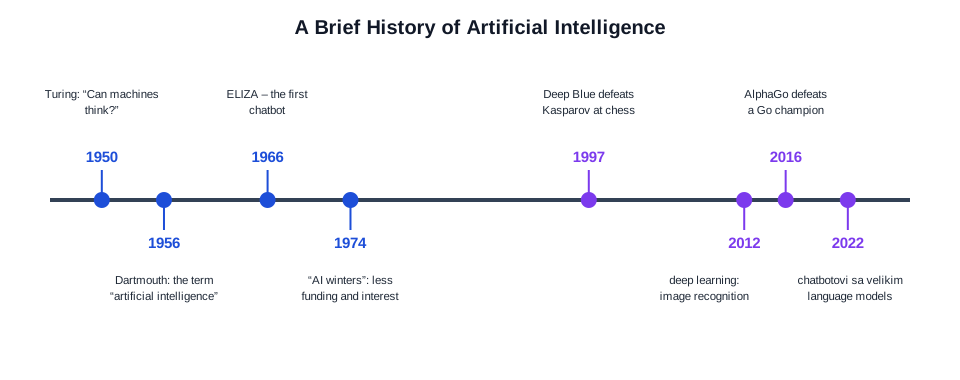
1950: Alan Turing and the question “Can machines think?”
The British mathematician Alan Turing, one of the founders of computer science, published a paper in 1950 in which he asked the question “Can machines think?”. Since “thinking” is hard to define, he suggested a game: if a person, talking through written messages, can't tell a computer from a human, the computer is behaving intelligently. This is the famous Turing test.
1956: the birth of the name
In the summer of 1956 a group of scientists gathered at Dartmouth College (USA) – among them John McCarthy and Marvin Minsky. For that meeting McCarthy suggested the name “artificial intelligence”. They were very optimistic: they believed that within a few decades machines would be able to do everything humans can.
The first programs: chess, checkers and ELIZA
- In the 1950s programs that play checkers and chess appeared. Arthur Samuel's checkers program even learned from the games it played – that is why Samuel is considered a pioneer of machine learning (he also coined the term).
- In 1958 Frank Rosenblatt built the perceptron – the first “artificial nerve cell” that learns. It is the forerunner of today's neural networks.
- Around 1966 Joseph Weizenbaum created ELIZA, the first well-known chatbot. ELIZA only turned sentences back into questions (“You say you are sad. Why are you sad?”), but some people thought it really understood them.
The “winters” of artificial intelligence
The promises were bigger than the possibilities. Computers were slow, memory was small and there was almost no data. In the 1970s and again at the end of the 1980s funding and interest dropped sharply. These periods are called “AI winters”.
In the meantime expert systems were used – programs with thousands of rules written by experts (for example doctors). They were useful, but hard to maintain: every new piece of knowledge had to be entered by hand.
1997: Deep Blue beats the world champion
In 1997 IBM's computer Deep Blue beat the world chess champion Garry Kasparov in a six-game match. Deep Blue didn't “learn” like today's models – with enormous speed it checked millions of possible moves per second.
From 2010: data, fast computers and deep learning
Three things came together: the internet brought huge amounts of data (images, texts), graphics cards made fast calculation possible, and old ideas about neural networks were improved. This is how deep learning (networks with many layers) came about.
- 2012 – the neural network AlexNet far outperforms other programs in an image recognition competition. Rapid development begins.
- 2016 – the program AlphaGo (by the company DeepMind) beats one of the best players of the game Go, Lee Sedol. Go has many more possible moves than chess, so this was thought to be still far away.
- 2017 – researchers publish the transformer model, a way of building neural networks on which today's language models are based.
From 2022: chatbots and generative AI
At the end of 2022 ChatGPT appeared, and then other chatbots (Gemini, Claude, Copilot…). For the first time, a large number of people could talk to artificial intelligence in ordinary language. Besides text, AI today also makes images, music and video – this is called generative artificial intelligence.
You will see how these models work and who makes them in the lesson Who makes artificial intelligence.
What history teaches us
- Progress didn't go in a straight line – there were also big disappointments.
- Many “new” ideas are old: neural networks have existed since 1958, but they took off only when there was enough data and fast computers.
- From the start, people have tended to overestimate how much a machine “understands” (remember ELIZA).
Activity: put the events in order
Put the events in order from the oldest to the newest: (A) AlphaGo wins at Go, (B) the name “artificial intelligence”, (C) Deep Blue beats Kasparov, (D) Turing's paper “Can machines think?”, (E) the appearance of ChatGPT, (F) ELIZA.
Solution
D (1950) → B (1956) → F (around 1966) → C (1997) → A (2016) → E (2022).
Hand out the cards to groups; the groups lay out a timeline on the desk, then compare it with the picture at the beginning of the lesson.
Common misconceptions
- “AI was invented a couple of years ago” – the name has existed since 1956, and the first programs that learn since the 1950s.
- “Deep Blue was as “smart” as a human” – it only played chess, and it did so by checking a huge number of moves – it couldn't do anything else.
Practice tasks
Try it yourself first, and only then open the solution.
- Why did Turing suggest a game (a test) instead of the question “Can a machine think?”
- What are “AI winters”, and why did they happen?
- Name three things that made artificial intelligence advance rapidly after 2010.
Solution 1: explanation
Because the word “think” is hard to define exactly. The game gives something that can be checked: whether a person can tell a machine from a human based only on the answers.
Solution 2: explanation
These are periods when funding and interest in artificial intelligence dropped sharply. They happened because the promises were bigger than the possibilities: computers were slow, there was little memory and data, so programs couldn't do what was expected.
Solution 3: answer
A lot of data (the internet), fast computers (graphics cards) and improved neural networks (deep learning).
Check your knowledge
Open the quiz
Quiz: history of artificial intelligence
1. Who asked the question “Can machines think?” in 1950?
2. When did the name “artificial intelligence” appear?
3. What are “AI winters”?
4. Which program beat a top Go player in 2016?
5. What made the rapid progress after 2010 possible?