
What is artificial intelligence?
When you unlock your phone with your face, when YouTube suggests the next video or when a translator translates a sentence into English – artificial intelligence is at work (AI for short).
In this lesson you will learn how artificial intelligence differs from an “ordinary” program, where you already use it and what it can't do (yet).
A simple definition
Artificial intelligence is a field of computer science that makes programs that solve tasks that would otherwise need human intelligence: recognizing an image or a voice, understanding text, predicting something or making a decision.
It is important to remember: artificial intelligence is still a program that runs on a computer. The difference is in how that program “knows” what to do.
An ordinary program and artificial intelligence
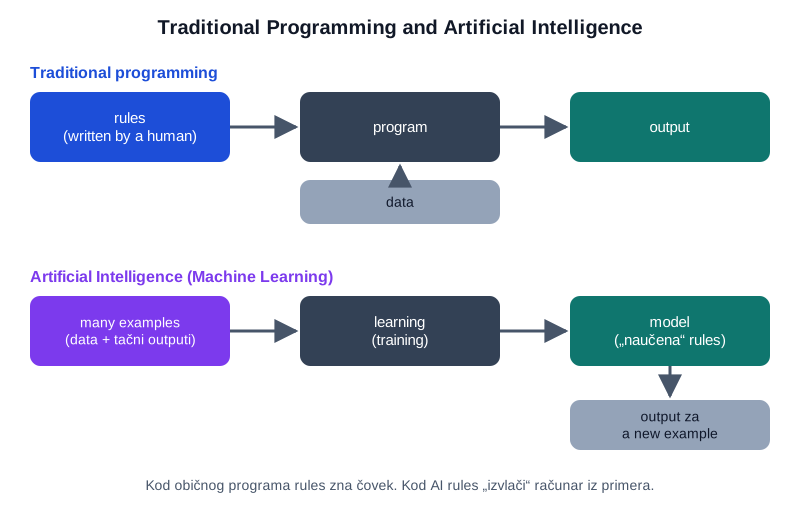
Let's take a task: recognize whether there is a cat in an image.
- An ordinary program would need rules written by a person: “if it has two pointed ears, whiskers and a tail…”. But how do you describe an ear in every photo, from every angle, in every light? Such rules are almost impossible to write.
- Artificial intelligence works differently: we show it thousands of images labeled “cat” or “not a cat”. The program finds by itself what they have in common. This process is called machine learning, and what is created is a model.
| An ordinary program | Artificial intelligence (machine learning) | |
|---|---|---|
| who comes up with the rules | programmer | the computer, from examples |
| what is needed | an exact procedure (algorithm) | many examples (data) |
| when it gets something new | it does exactly what is written | it tries to “guess” based on what it has learned |
| mistakes | it repeats the same mistake until the programmer fixes it | it sometimes makes mistakes even when everything was made “correctly” |
| example | a calculator, a traffic light with a timer | face recognition, a translator, a chatbot |
Where you already use artificial intelligence
| Where | What AI does |
|---|---|
| phone | unlocking with your face, enhancing photos, speech recognition |
| YouTube, TikTok, games | suggests the next video or content based on what you have watched |
| translator | translates sentences from one language into another |
| separates unwanted mail (spam) | |
| navigation in the car | estimates traffic jams and suggests a faster route |
| chatbots (ChatGPT, Gemini, Claude…) | answer questions and write text |
| medicine | helps doctors spot diseases on scans |
You use most of these things every day without thinking about it. That is why it is important to understand how they work – and when you shouldn't trust them without checking.
What artificial intelligence can't do
- It doesn't understand the world like a person. A model that recognizes cats doesn't know what a cat is – it only knows what images labeled “cat” look like.
- It makes mistakes. It can confidently write an incorrect fact or wrongly recognize an image.
- It depends on data. If it learned only from images of black cats, it may not recognize a white cat.
- It has no wishes of its own. It does the task it was made for and that a person gives it.
We will talk about whether AI “thinks” or is conscious in a separate lesson – it is one of the most interesting questions in today's science.
Activity: AI or not AI?
For each device or program decide: does it use artificial intelligence (does it learn from examples) or does it work by rules written by a person?
- the calculator on your phone
- a filter that separates unwanted mail
- a traffic light that changes every 30 seconds
- an app that recognizes a plant from a photo
- an alarm clock
- a voice assistant (“Hey, …”)
- the automatic watering program from the Arduino lesson
- suggesting the next word while you type a message
Solution
AI: 2, 4, 6, 8. Not AI (rules): 1, 3, 5, 7. The garden watering uses a rule we wrote ourselves: “if the humidity is below the threshold – turn on the pump”. If the program learned the threshold by itself from measurements and from how the plant grows, that would already be machine learning.
Students sort the examples in pairs, then each pair explains one choice. At the end, add more examples from everyday life together.
Common misconceptions
- “AI is a robot” – most artificial intelligence has no body; it is programs on computers and phones. A robot may (but doesn't have to) use AI.
- “AI always knows the correct answer” – a model gives the most likely answer based on what it has learned; it can be wrong.
- “AI is something completely new” – the idea is over 70 years old – that is the topic of the next lesson.
Practice tasks
Try it yourself first, and only then open the solution.
- Explain in your own words the difference between an ordinary program and artificial intelligence (2–3 sentences).
- Name three places where you used artificial intelligence this week.
- A plant recognition app learned only from photos taken during the day. How do you think it will work on a photo taken at night? Why?
Solution 1: an example answer
An ordinary program works by rules written by a programmer. Artificial intelligence “learns” the rules by itself from many examples, so it can recognize even things the programmer didn't describe, but because of that it sometimes makes mistakes.
Solution 2: possible answers
For example: video suggestions on YouTube, unlocking the phone with your face, a translator, spam filtering, next-word suggestions on the phone keyboard, navigation.
Solution 3: explanation
Probably worse – it could make a mistake or not recognize the plant. The model knows only what it has “seen” in the examples, and night photos are darker and have different colors. That is why training data should be varied.
Check your knowledge
Open the quiz
Quiz: what is artificial intelligence
1. What is the main difference between an ordinary program and machine learning?
2. What is a “model”?
3. Which of these examples does NOT use artificial intelligence?
4. Why can a model that learned only from daytime photos make mistakes on night photos?