
The micro:bit in learning programming and in everyday life
The micro:bit is a compact microcontroller device developed as an educational tool for programming and electronics. The first version (V1) is based on a 32-bit ARM Cortex-M0 processor running at 16 MHz, with 16 KB of RAM and 256 KB of flash memory. The newer version (V2) has a faster ARM Cortex-M4 processor (64 MHz), 128 KB of RAM and 512 KB of flash memory, as well as a microphone and a speaker. Both have built-in sensors, including an accelerometer and a magnetometer (compass), an LED matrix of 5x5 LEDs, two buttons, a radio for communication between micro:bits and Bluetooth support. These technical features make it excellent for educational projects and simple prototypes.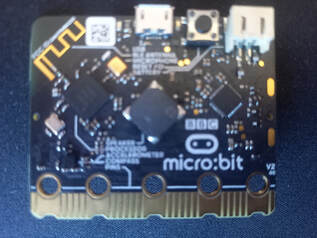
Examples of using the micro:bit
- An electronic compass:
The micro:bit has a built-in magnetic field sensor, which makes it possible to create a compass. This project helps students understand orientation and the use of sensors in real applications. - A digital step counter (pedometer):
Using the accelerometer, the micro:bit can measure movements and count steps, which is an excellent example of a motion sensor in action. - An automatic light switch:
The micro:bit can control an LED light using the light sensor – a practical project for learning automation and controlling light based on the light level around it. - Wireless data transfer: Students can use the built-in radio to send data between two micro:bit devices, such as temperatures or messages, which helps them understand the basics of wireless communication.
- Interactive games: By programming simple games (such as rock-paper-scissors) on the micro:bit, students can understand the logic of conditional statements, loops and reacting to events.
These examples cover key areas such as sensors, logic, wireless communication and interaction, which makes learning more fun and helps develop programming thinking through practical projects.
Other uses of the micro:bit
The micro:bit offers possibilities beyond programming, letting students explore how technology can be used to solve everyday problems:
- An obstacle detection system:
A micro:bit can be attached to a white cane for blind people and use an ultrasonic sensor to detect obstacles, warning the user with vibration or sound. - A safety alarm for vehicles:
The micro:bit can measure acceleration and detect sudden movements, which can be used as an alarm for drivers or even as part of a collision detection system. - A smart plant thermometer:
Connected to a temperature and moisture sensor, the micro:bit can follow the conditions around it and tell the user when the plants need watering. - A smart watch or a physical activity counter: The micro:bit can follow movements and measure activities such as running, which makes it suitable for tracking physical activity.
- An alarm for opening doors or windows:
Using a motion sensor, the micro:bit can detect when doors or windows are opened and send a warning, which can help secure a home.
These examples show how the micro:bit can be adapted to different areas such as medicine, safety, the environment and automation in everyday life, giving users a wider picture of how useful it is and of its potential.
Check your knowledge
Open the quiz
The micro:bit in everyday life
1. Which sensor of the micro:bit measures tilt and shaking?
2. How do micro:bit devices send messages to each other without a cable?
3. What is the micro:bit NOT suitable for?